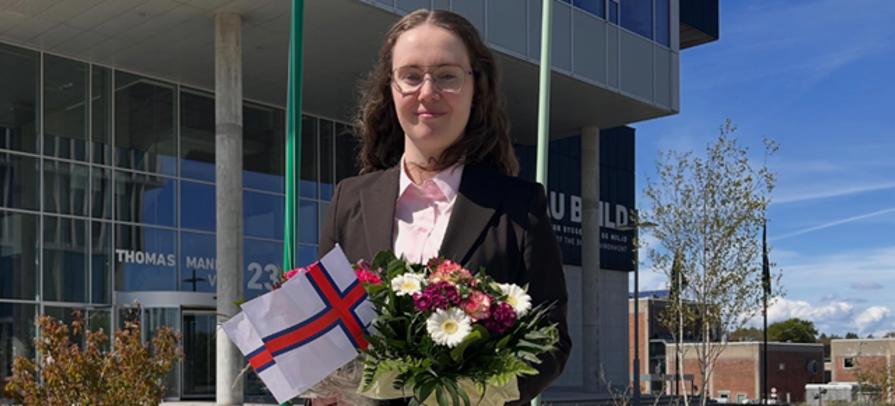
Tóra Oluffa Stenberg Olsen vart ph.d. á Aalborg Universitet
Fríggjadagin 8. mai vardi Tóra Oluffa Stenberg Olsen ph.d.-ritgerð sína í støddfrøði á Aalborg Universitet.
Ritgerðin ber heitið: ”Statistical modelling of lineage marker data in forensic genetics".
Í stuttum snýr ritgerðin seg um hagfrøðiliga myndlan av DNA dátum frá ættarmarkørum innan rættargenetik. Rættargenetikkur fevnir um at greina DNA-royndir frá brotsstøðum og samanbera tær við royndir frá teimum, ið eru undir illgruna fyri at hava framt brotsverkið, fyri at fáa greiðu á leikluti teirra í brotsverkinum. Á hendan hátt kann ein, ið er undir illgruna, verða útilokaður sum gevari av einum DNA-spori, um DNA-profilur hansara ikki samsvarar við DNA-prógvið frá brotsstaðnum. Men um DNA-profilurin hjá einum undir illgruna samsvarar við DNA-prógvið, skal vektin av samsvarinum ásetast, tí DNA-profilar hjá fleiri einstaklingum kunnu samsvara við sama DNA-prógvið.
Ritgerðin gevur nýggj innlit í nýtslu av dátugrunnum grundaðir á Y-kromosomið til at eyðmerkja møgulig brotsfólk í teimum førum, har eingin er undir illgruna, og veitir nýggjar tilgongdir og myndlar til at betra um ásetanina av vektini av einum samsvari millum DNA-profilar grundaðir á ávíkavist Y-kromosomið ella mitokondriu DNA.
Tóra hevur verið innskrivað til ph.d.-lestur á Institut for Matematiske Fag.
Mikkel Meyer Andersen, lektari, hevur verið høvuðsvegleiðari.
Í metingarnevndini vóru:
Anne Marie Svane, lektari á Aalborg Universitet, forfólk
Corina Benschop, ph.d., granskari á Netherlands Forensic Institute
Niels Richard Hansen, professari á Københavns Universitet
Tóra heldur fram í post.doc. starvi á Aalborg Universitet.
Sí akademiskan vangan her
Mynd: © Privatmynd
Abstract
Forensic genetics using DNA information can offer invaluable insights to assist in solving, e.g., criminal, immigration, and paternity cases. This thesis provides new insights into using Y-chromosomal databases for identifying investigative leads in cases with no suspects, and frameworks to improve the evidential weight assessment for Y-chromosomal DNA profiles and mitochondrial DNA (mtDNA) profiles, respectively.
In paper A, we quantified the success rate of obtaining investigative leads when searching for paternal relatives of a Y-chromosomal evidence profile donor in Y-chromosomal databases, providing essential information for considerations on establishing or adjusting such databases as well as insights to the applicability of such searching strategies for forensic investigations.
In paper B, we extended the applications of a method used for the evidential weight assessment for Y-chromosomal profiles to handle cases with incomplete profiles. Since incomplete profiles may occur in forensic analyses, mainly caused by low quantity or quality of the DNA evidence sample, a framework for handling these cases is needed.
In paper C, we investigated if specific populations, used for the evidential weight assessment of Y-chromosomal profiles, could be identified using only genetic information. Since the evidential weight assessment depends upon the selection and composition of the population used, these analyses provide important insights for forensic genetic analyses.
In paper D, we developed a method for population frequency estimation of mtDNA profiles utilizing larger mtDNA databases, containing only partial information on the mtDNA sequences, than current complete mtDNA sequence databases, illustrating the potential to strengthen the evidential weight evaluation compared to current state-of-the-art methods.
In paper E, we developed modelling approaches to improve the evidential weight evaluation of complete mtDNA sequences by utilizing all the available information.